RetiJev: Ophthalmic Decisions and Guideline Grading
Self-hostTerminalSelect investigations, referrals and grading options from clinical text with an open ophthalmic research model.
by admin · listed 2 hours ago
⚡ What System1 does here
About
RetiJev is an ophthalmic decision-model family developed by researchers at the National University of Singapore and collaborating institutions. It takes a patient description, a question and predefined answers to support research on investigation selection, referral, urgency, plan safety and guideline grading. Its input is clinical text, rather than retinal photographs.
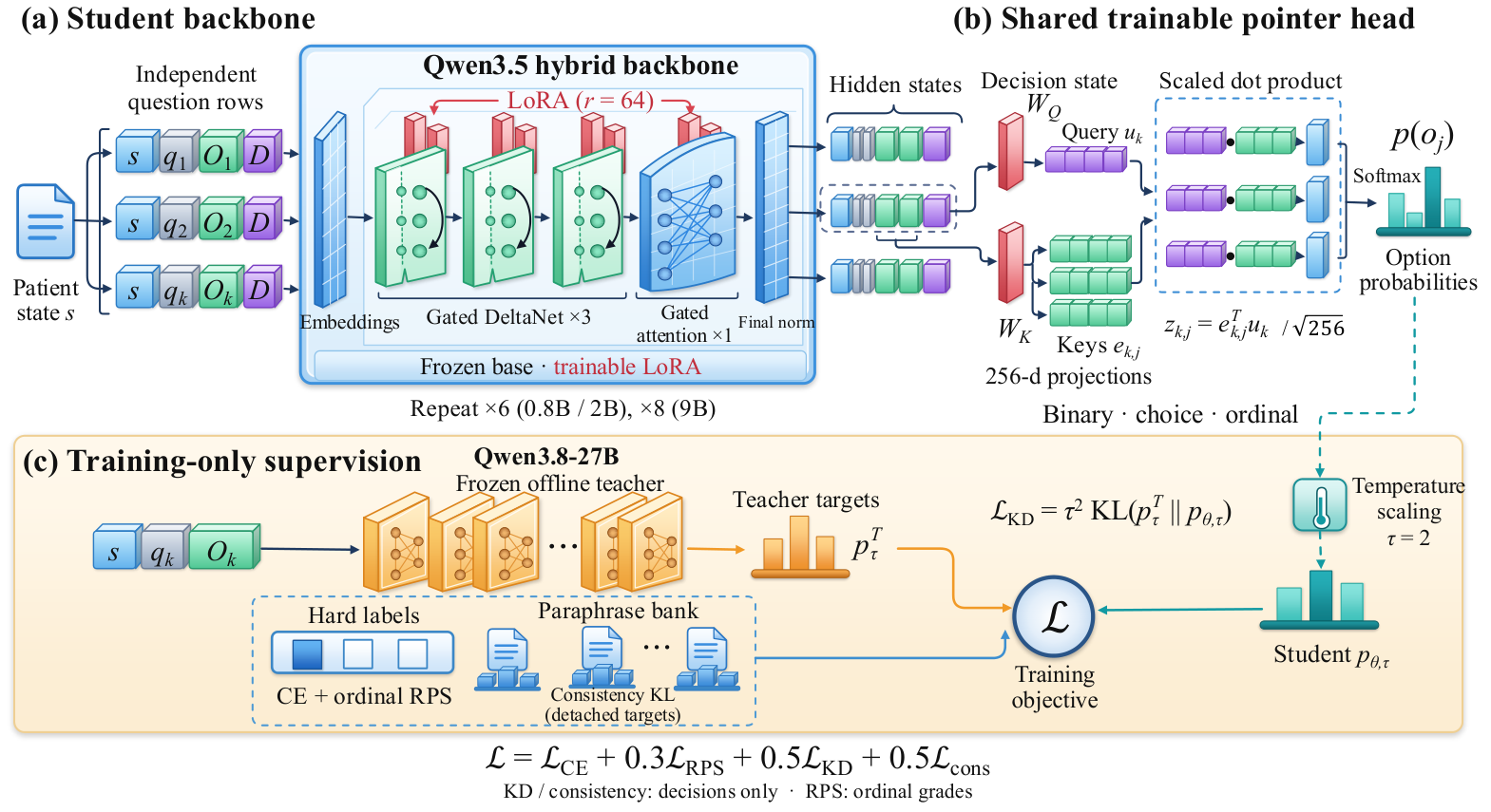
How it works The 0.8B, 2B and 9B variants combine a Qwen3.5 backbone with trained LoRA adapters and a shared candidate-scoring head. Multiple questions reuse one patient context and receive independent scores, without generating an answer token by token. This is an independent open research project, not an official TypeSafe Jev product. A research workflow can prepare a de-identified case, supply a question and allowed options, and obtain candidate probabilities. The application can display these alongside separately associated references for review; the model itself does not retrieve sources or generate citations. Applications can include clinician deferral among the options when information is insufficient. Any operational deferral threshold still needs validation for the intended setting.
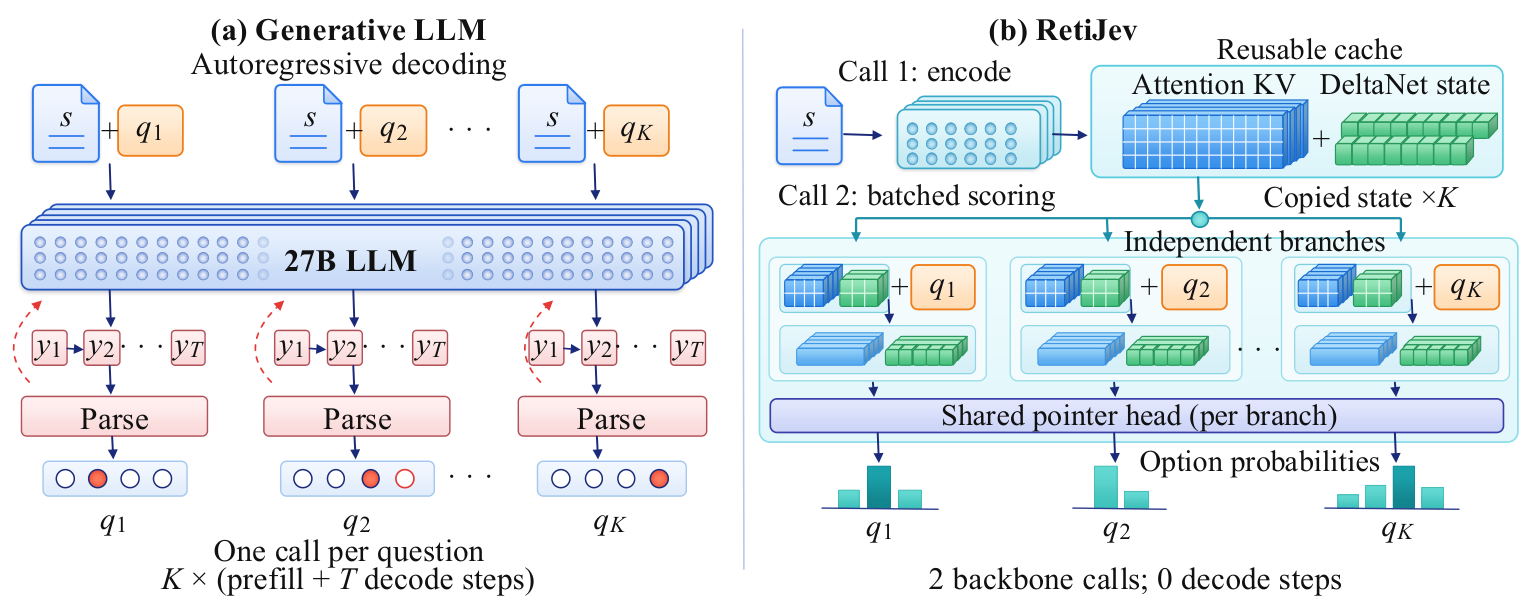
What the paper reports On synthetic cases, the authors report 84.9% Decision-Unseen accuracy for RetiJev-9B, compared with 79.5% for each of two baselines. The 9B model has a median case-level latency of 158 milliseconds on one NVIDIA H200 with batch size 1 and an average of 2.65 questions per case. This is a specified research measurement, not a hardware-independent guarantee or a clinical outcome. Local research and reproduction The repository provides installation instructions, command-line inference examples, training scripts and a small sample dataset. Model weights are available on Hugging Face; corresponding Qwen3.5 base weights and a local inference environment are required. This listing reviews public sources; we have not run the model or reproduced the benchmark. Evidence limits The cases are synthetic. Clinical-decision and diagnosis labels were cross-checked by models, rather than adjudicated case by case by ophthalmologists. There has been no prospective clinical evaluation. The project is for research and is not a clinically validated medical device. Candidate probabilities are not an individual patient's probability of a correct diagnosis. Media Two original technical figures from the paper are retained. No public demo recording was found in the inspected repository, releases, author model page or paper. A command-line demo is not a demonstration video. Sources Bo Liu, Lianyu Wang, Meng Wang, Ching-Yu Cheng and Huazhu Fu. RetiJev: Fast and Source-Grounded Ophthalmic Decision Models (2026). https://arxiv.org/abs/2610.30947 Code: https://github.com/Awenbocc/RetiJev Models: https://huggingface.co/BoKelvin/RetiJev Discovery source: https://mp.weixin.qq.com/s/P8QM7QpQT_qmsu9k0c0AwQ